
Post
Billiard Training Kit – Cue Ball Target Rings and Position Training Set
May
Improvement in billiards is rarely the result of playing more games alone. Real progress comes from deliberate, structured practice that isolates specific skills, exposes weaknesses, and forces repetition under controlled conditions. The Billiard Training Kit – Cue Ball Target Rings and Position Training Set is designed precisely for this purpose, turning ordinary table time into focused training sessions that accelerate skill development far beyond casual play.
The Difference Between Playing and Practicing
In billiards, there is a clear distinction between playing matches and training. Playing is reactive — you respond to whatever layout appears on the table, make decisions in real time, and focus on scoring or winning. Training, however, is intentional and repetitive. It is the process of creating controlled shot situations and repeating them until consistency is achieved.
Without structured training, many players plateau for years. They become familiar with the game but do not systematically improve specific weaknesses such as cue ball control, positional accuracy, or speed control. The training kit solves this problem by providing a framework that converts time at the table into purposeful skill building rather than random play.
Cue Ball Target Rings: Objective Position Control
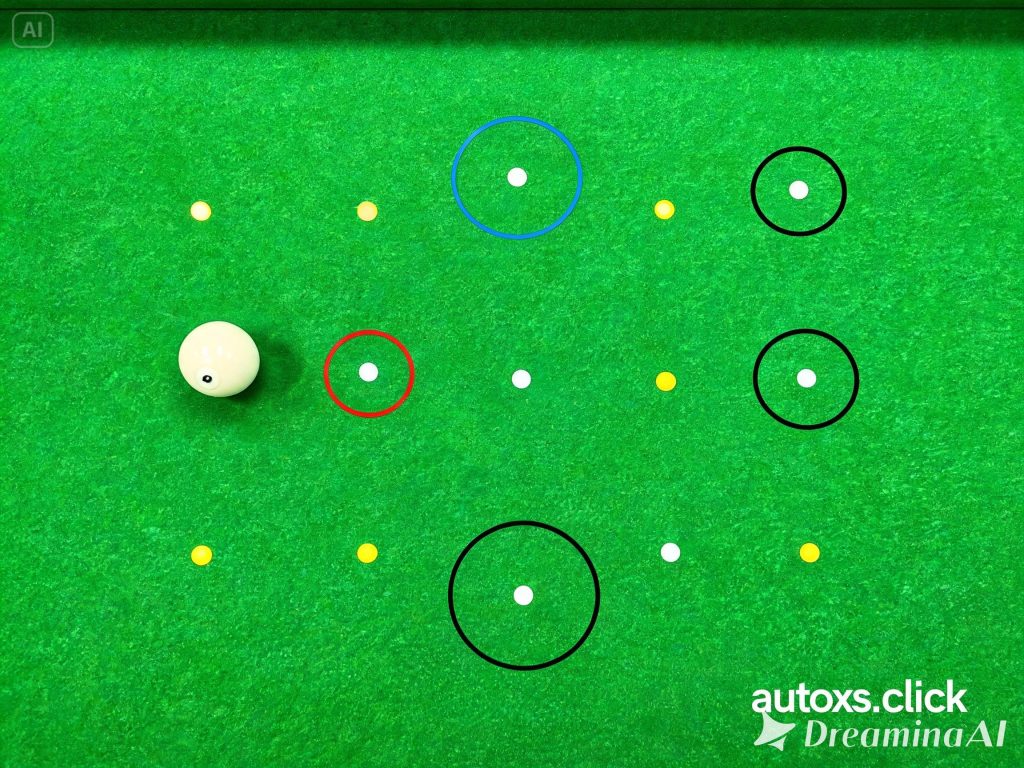
One of the most powerful components of the kit is the set of cue ball target rings. These flexible markers are placed directly on the cloth to define precise landing zones for the cue ball after a shot. Instead of relying on subjective judgment like “close enough,” players now work toward a clearly defined objective: landing the cue ball within a specific boundary.
This shift from subjective to objective feedback is crucial. When a player can visually confirm whether the cue ball landed inside or outside the target zone, improvement becomes measurable. Over time, this leads to better understanding of speed control, spin application, and positional planning.
Target rings are typically used to simulate ideal positions for subsequent shots. For example, a ring might represent the perfect angle for a follow-up pot, forcing the player to not only pocket the current ball but also position the cue ball correctly for the next action. This builds the foundation of strategic positional play rather than isolated shot-making.
Position Training and Table Awareness
Position play is one of the defining skills in advanced billiards. It requires the player to control not just where the cue ball goes, but how it arrives there — including angle, speed, and spin. The training kit encourages this by repeatedly placing players in scenarios where cue ball control determines success or failure.
Through repeated drills, players develop a more intuitive sense of how the cue ball reacts to different types of strokes. Small adjustments in cue speed or tip contact begin to produce predictable differences in outcome. This awareness is what separates recreational players from competitive players.
Structured Drill Systems for Skill Development
The kit supports multiple structured practice drills that target different aspects of the game:
Line drills focus on straight-line cue ball control and consistent pocketing while managing cue ball return paths. These exercises build foundational control over follow and draw shots.
Clock drills place object balls in circular positions around the table, challenging players to control cue ball direction from a central starting point. This improves directional awareness and shot planning from neutral positions.
Pattern drills introduce multi-shot sequences where players must think ahead, planning not just the current shot but the next position as well. These exercises develop strategic thinking and sequence planning, which are essential in competitive play.
Repetition and Motor Learning
Skill development in billiards is fundamentally a process of motor learning. Each correctly executed repetition strengthens the neurological pathways responsible for stroke consistency, alignment, and cue control. Over time, these movements become increasingly automatic, requiring less conscious effort and producing more reliable results.
The training kit enhances this process by ensuring that each repetition is performed under consistent conditions with clear feedback. When a player repeats the same controlled shot dozens or even hundreds of times, small adjustments in stance, bridge stability, or stroke speed become noticeable and correctable.
This type of repetition builds muscle memory and stroke confidence, which are essential for performing under pressure in real matches.
Skill Progression Across All Levels
The system is effective across all skill levels. Beginners benefit from basic cue ball control exercises that teach fundamental concepts such as straight stroke alignment and basic follow/draw behavior. Intermediate players use more complex drills that introduce multi-shot positioning challenges and controlled spin applications.
Advanced players benefit from precision training, where even small deviations from target zones reveal inconsistencies in their stroke mechanics or decision-making. At this level, the training kit becomes a tool for refinement rather than basic learning.
Because of this scalability, the kit remains useful throughout a player’s development journey, continuously providing appropriate challenges as skill level improves.
Developing Real Match Consistency
One of the most important benefits of structured training is the transfer of skills to real match conditions. In competition, players must perform under pressure, often with limited time for decision-making. Skills developed through repetition and controlled drills become instinctive responses under stress.
Players who train with clear objectives and feedback systems are better equipped to maintain consistency in real matches because their execution has been tested and refined under repeatable conditions.
Enhancing Practice Efficiency
Without structure, practice sessions can become repetitive without being productive. Players may spend hours at the table without addressing specific weaknesses. The training kit improves efficiency by giving each session a defined purpose, ensuring that every minute spent at the table contributes to measurable improvement.
This focused approach also reduces frustration, as players can clearly see progress over time through improved accuracy within target zones and more consistent cue ball control.
Conclusion
The Billiard Training Kit – Cue Ball Target Rings and Position Training Set transforms ordinary practice into structured, goal-oriented training. By introducing measurable targets, repeatable drills, and focused skill development, it provides a clear pathway for improvement at every level of play.
For players who are serious about advancing their game, this kit offers the structure needed to turn time at the table into real, lasting progress — building not just better shots, but better players.
